NRNA: The Challenge of Clean Leadership and Restoring Lost Prestige After Unity
- Biswasdip TIGELA

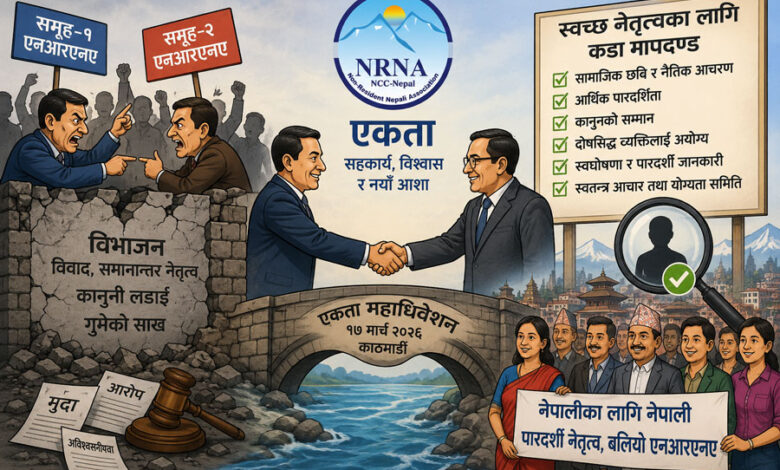
The Non-Resident Nepali Association (NRNA) is an organization established with the objective of connecting Nepalis scattered across the world onto a single shared platform. Moving forward under the core motto “For Nepalis, By Nepalis,” this organization at one time earned distinct trust, attraction, and prestige among Non-Resident Nepalis globally. NRNA has played a vital role in connecting the knowledge, skills, capital, and experience of non-resident Nepalis to the economic, social, and humanitarian development of Nepal. However, over the past few years, extreme disputes, factionalism, parallel leaderships, and legal battles within the organization severely damaged its reputation.

Ending this long-standing division, hope has been reignited within the organization after a consensus leadership was selected during the Grand Unity National Convention held in Kathmandu on March 17, 2026, between the NRNA led by Mahesh Shrestha and the NRNA led by Dr. Badri KC. Along with the spirit of unity initiated at the central level, the progress of the unification process across various National Coordination Councils (NCCs) worldwide is a very positive development. Bringing this institution—battered by long-term division—back into a single fold is a major opportunity to restore NRNA’s lost prestige. But the question arises: Does coming together of two factions mean all of NRNA’s problems are solved? The answer is not simple.
Severe Damage Caused by Division
In any democratic organization, differences of opinion regarding ideas, policies, and leadership are natural. Competing for leadership is also not wrong; healthy competition can make an organization more dynamic. However, the dispute within NRNA was not limited to normal ideological differences. Controversies over leadership, elections, delegate selection, and the legitimacy and authenticity of the General Convention divided the organization into competing factions for a long period.
Seeing different leaderships, parallel programs, and conflicting claims under the name of a single NRNA naturally created deep confusion among ordinary Non-Resident Nepalis worldwide. The emergence of the question, “Which one is the official NRNA?” was a serious blow to the institution.
As a result, not only was the internal strength of the organization weakened, but its credibility was also called into question among the Government of Nepal, diplomatic missions, the business community, and Nepalis worldwide. Institutional reputation built over decades was badly eroded by a few years of infighting.
Therefore, the recent unity is not merely a simple political or organizational compromise. It must be taken as the starting point for NRNA’s institutional reconstruction.
Not Just Unity, Cleanliness is Also Required Now
If NRNA is to be rebuilt into a strong organization post-unity, an honest review must be conducted on why the organization split in the first place. Merely blaming individual figures will not provide a long-term solution. If flaws lie within the structure and system of the organization, those must be reformed.
In particular, the current debate should not be limited to “Who will lead?” Rather, the time has come to answer the question: “What kind of person should be eligible to lead NRNA?”
The social standing, financial transparency, respect for the law, and moral conduct of an individual sitting at the helm of a globally prominent public organization like NRNA are directly linked to the organization’s reputation.
In recent years, news regarding allegations, investigations, and legal disputes related to fraud, financial irregularities, or other criminal offenses involving some current or former office-bearers and influential individuals associated with NRNA has surfaced in the media. Such incidents harm not only the individuals concerned but also the image of the organization they represent.
One principle must be made clear here: being accused of an offense and being proven guilty by a court are two entirely different things. Until legally proven guilty, a person cannot be termed a criminal. Since allegations can also stem from political, personal, or commercial vendettas, stripping someone’s rights purely based on allegations is not just.
However, the other side of this is equally important. It is entirely reasonable for higher moral standards to apply to individuals seeking to lead public institutions compared to ordinary members.
Strict Criteria Necessary Right From the Upcoming Election
Therefore, starting from the upcoming election itself, NRNA needs to incorporate clear “Fit and Proper” or moral qualification standards into its constitution or election regulations for leadership candidates.
Clear provisions should be made to disqualify individuals convicted by a court of fraud, corruption, money laundering, organized crime, or other serious criminal offenses from contesting for leadership above a certain level in NRNA.
When it comes to individuals with sub-judice cases or pending charges, even greater caution is required. No one should be declared a criminal solely on the basis of an accusation. However, if formal criminal charges of a severe nature have been filed, an independent Ethics and Qualifications Committee could be formed to evaluate candidate eligibility. This committee could examine the laws of the respective jurisdiction, the nature of the case, and the judicial status to render an impartial decision.
In this way, by distinguishing between convicted individuals and merely accused individuals, both legal justice and institutional ethics can be balanced.
A mandatory self-declaration requirement for candidates regarding their criminal and financial background would also be highly effective. Clear provisions are necessary to cancel a candidature or remove an elected official from office if it is proven that they concealed serious cases, convictions, or conflicts of interest, or submitted false declarations.
Such measures should not be introduced as rules designed to block specific individuals or groups, but rather as long-term institutional cleansing for NRNA. The rules must apply equally to everyone—whether a multi-millionaire entrepreneur, a former office-bearer, someone close to the founders, or an individual with immense political clout.
NRNA Must Not Become a Laundering Tool for Personal Image
Leadership in NRNA has become an attractive avenue for acquiring social prestige. Its positions bring public recognition and direct engagement with high-level officials of the Government of Nepal, political leadership, diplomatic bodies, the business sector, and the Nepali community worldwide.
Because of this prestige, if someone uses the reputation earned through their legitimate business or social work to serve society through NRNA, that is welcome. However, if an individual convicted of fraud or serious crimes seeks to hide their past negative image, manufacture social standing, or use NRNA’s title and influence as a “laundering tool” to clean their image, it is fatal for the organization.
NRNA must not become a “laundry” for cleansing anyone’s controversial past. Rather than an individual building their image using the institution’s reputation, the clean character and contribution of the individual should elevate the institution’s stature.
If this is not checked in time, when the name of someone holding a high position in NRNA is linked to fraud or criminal offenses in the future, society will not question just that individual; the overall perspective toward the entire organization will be compromised.
Therefore, if clean image, social contribution, financial transparency, and lawful conduct can be set as core qualifications for candidates starting from the upcoming election, the organization will survive and its reviving prestige will rise further.
Ending the Culture of Buying Leadership with Money
Another major challenge for NRNA is excessive election spending and financial influence. If NRNA elections come to be viewed as abnormally expensive among social organizations globally, that cannot be a matter of pride.
If reaching leadership requires spending massive sums of money, honest yet financially modest individuals will automatically be priced out of the competition. There is then a danger that financial strength, rather than social service, intellectual contribution, experience, and capability, will become the primary basis for leadership selection.
NRNA is not an organization exclusively for wealthy Nepalis. It is a shared platform for all non-resident Nepalis—from workers sweating in the scorching heat of the Gulf to businesspersons, students, scientists, professors, ex-servicemen, journalists, doctors, and professionals across the UK, USA, Australia, Europe, and other regions.
Hence, establishing spending limits for elections, mandatory disclosure of income and expenses, and a transparent electoral system is essential.
NRNA Above Political Parties
It is natural for non-resident Nepalis to hold personal political views. Someone may favor Congress, UML, or any other party or ideology. That is an individual’s democratic right.
However, NRNA’s institutional leadership selection must not become a testing ground for Nepal’s political parties’ power dynamics. If a culture develops where NRNA leadership is formed based on blessings from leaders in Nepal, party alignments, or political influence, the organization’s independence will be eroded.
It is imperative to keep NRNA above political ideologies as an independent body working strictly for the common interest of Nepalis worldwide.
Do Not Waste the Current Opportunity of Unity
The unity achieved on March 17, 2026, has opened the door to escape the division seen over the past few years. Following the consensus at the central level, the ongoing process of unification across National Coordination Councils in various countries sends a positive message.
This is not merely about two groups joining together; it is an opportunity to restore lost trust.
Now is not the time to keep dividing shares between old and new factions, or between ‘our group’ and ‘their group’. An organization cannot move forward by engaging in endless blame games over past mistakes. The wise approach is to learn from those mistakes and correct institutional weaknesses.
To sustain the reviving reputation of NRNA post-unity, the institution must never compromise on four core values: Unity, Transparency, Clean Leadership, and Accountability.
In particular, the upcoming election will be a test for NRNA. If it reverts to the old style of accusations, financial influence, factionalism, and competition among controversial figures, the achievements of the current unity will not last long.
However, if reforms are introduced in the constitution and election regulations to prevent individuals convicted of serious fraud or criminal offenses from reaching leadership, conduct impartial eligibility checks for pending serious charges, ensure transparency in candidate backgrounds and financial details, and penalize those submitting false declarations, NRNA can pioneer a new organizational culture.
Conclusion
NRNA is not the private property of any president, general secretary, vice president, faction, or a select group of businesspersons. It is a shared platform for non-resident Nepalis scattered across the globe. The labor, time, and contributions of thousands of volunteers, as well as the emotions of millions of Non-Resident Nepalis, are invested in it.
Division weakened NRNA. Controversy eroded trust. Serious legal and ethical questions raised against some individuals holding or seeking leadership created further challenges for the organization’s image. Now, unity provides a historic opportunity to rectify those shortcomings.
However, unity alone is not enough—institutional purification must also take place.
NRNA must not serve as a platform for individuals involved in fraud or criminal convictions to reconstruct their social reputation. Instead, an environment should be fostered where honest, capable, transparent, and dedicated individuals come to serve within NRNA.
If a strong system regarding the ethical and legal qualifications of candidates can be implemented starting from the upcoming election, it will send a clear message: NRNA requires character, not just money, access, and influence.
Ultimately, no individual is bigger than the institution. Reputation is bigger than position, and trust is bigger than reputation.
The responsibility to safeguard the trust that is gradually returning through this current unity—or to throw it back into past disputes—now lies in the hands of the NRNA leadership and its members worldwide. If clean leadership, transparent elections, financial accountability, and institutional discipline can be established, NRNA will not only recover its lost prestige but will also re-establish itself as an even stronger global Nepali institution in the future.
(Author: Vice President, NRNA ICC)