Is Bhanu, Agam Singh, or Sudhapa the Symbol of Unity for Indian Nepalis?
— by Biswasdip TIGELA

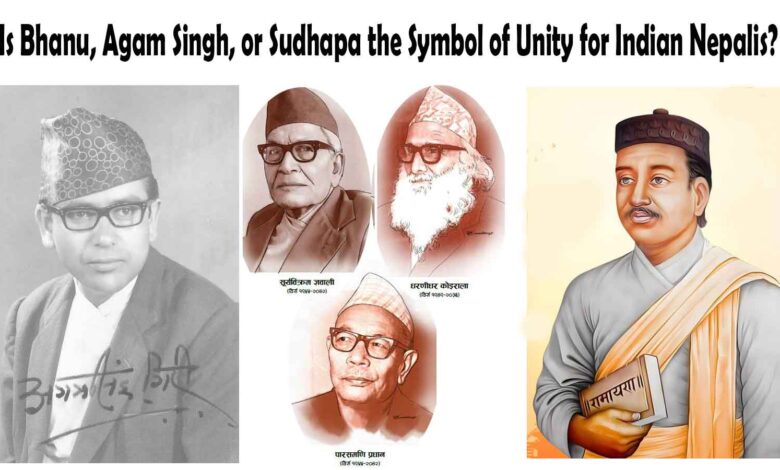
After India gained independence, Nepali-speaking people living in areas like Darjeeling and Kalimpong began to feel a stronger sense of identity as a Nepali race. In their search for a symbol of unity, they chose Bhanu Bhakta—the first person to translate the Sanskrit Ramayana into the Khas Nepali language. They created a fictional portrait and statue of him, and began celebrating Bhanu Jayanti as a Day of Unity for Nepali-speakers living outside Nepal. Through the active efforts of Surya Bikram Gyawali and the Nepali Sahitya Sammelan, a half-size bust of Bhanu Bhakta was erected for the first time at Chowrasta in Darjeeling in 1949. The sculptor of this statue was E. F. Thompson.
In 1992, during the height of the Gorkhaland movement, activists of the Gorkha National Liberation Front (GNLF) demolished this statue, arguing that they needed a symbol representing Darjeeling’s own identity rather than one representing Nepal. Later, around 1996, a full-sized statue of Bhanu Bhakta was rebuilt at Chowrasta, which is considered the first full statue of him. The Nepali Sahitya Sammelan rebuilt this statue as well, crafted by the sculptor Sri Mriganka Pal from Krishnanagar, Nadia, West Bengal. Around the same time, a statue of Agam Singh Giri (who was born in Darjeeling on July 27, 1927, and passed away on January 31, 1971) was established nearby at the Lewis Jubilee Complex. Subash Ghising, the leader of the GNLF, promoted Giri as a national poet and built this statue using government funds after the formation of the Darjeeling Hill Council in 1988. The Hill Council also started the Giri Puraskar in 1994, and the statue was built in the years between the formation of the council and the establishment of this award. This statue was not just a tribute to a writer, but also a political and cultural symbol of identity.

It can be assumed that the campaign to establish the Ramayana and its translator, Bhanu Bhakta, as the oldest “Adikavi” (pioneering poet) was a direct product of the Sudhapa movement (initiated by Surya Bikram Gyawali, Dharanidhar Koirala, and Paras Mani Pradhan) in Darjeeling. However, this raises several questions: Were there no books in Nepali older than the translated Ramayana? Did the indigenous communities living in Nepal since ancient times have their own books? Even if we judge by the base on Nepali language spoken today, was there really no older book than the Ramayana? Furthermore, since Bhanu Bhakta translated the Ramayana instead of writing it originally, how can he be called the Adikavi (pioneering poet)? To be a poet, shouldn’t one write original poetry? Although Bhanu Bhakta wrote other works like Prasnowttarmala, Bhaktamala, Badhusiksha, and Ramgeeta, the Ramayana remains the main basis for his fame. In reality, it was Motiram Bhatta who wrote about and popularized Bhanu Bhakta after his death. The story of Bhanu Bhakta and the grass cutter (Ghansi), which is highly popular, is used to establish him as an ideal figure. According to the story, the grass cutter saved money by cutting and selling grass to dig a well. But was grass really sold in Ramgha, Tanahun during that era? Is grass sold there even today? Certainly not. The grass cutter could have dug the well himself. Therefore, the poem and story of Bhanu Bhakta and the grass cutter is a beautiful, fictional tale rather than actual history. There is also an argument that since Raghunath Bhatta translated the Sundar Kanda (one of the seven chapters of the Ramayana) before Bhanu Bhakta, he should be considered the Adikavi.
While it is natural to base things on the modern, widely spoken Nepali language, why was the Ramayana chosen as the ultimate foundation? Inside Nepal, people often celebrate Prithvi Jayanti as their symbol of unity. However, Nepali-speaking Indian citizens cannot celebrate the unity day of someone who expanded the borders of Nepal, nor do general Indian national holidays fully represent their distinct identity. Hence, they created their own symbol. Even as Bhanu Bhakta is accepted as a symbol of linguistic unity, many debates persist. In Nepal, some view King Prithvi Narayan Shah as a unifier, while others see him as a conqueror and refuse to accept him as a symbol of unity. If so, why not accept Bhanu Bhakta as the symbol of unity instead?
Even today, Bhanu Jayanti is celebrated with great joy as a festival of unity among Nepali speakers in Sikkim, Darjeeling, and Assam. It is not celebrated as widely in Nepal because Nepal has a different historical day of unity. Many in Nepal argue that the story of Bhanu and the grass cutter is merely a story, not history. Those who question his status as the first poet believe that there were certainly other poets who wrote in scripts like Kharosthi, Ranjana, Kirat, and Tamiyik hundreds of years earlier. Additionally, the movement to call the language “Nepali” instead of Khas, Parbate, Pahadiya, or Gorkha language began in Kolkata under the pressure of the Sudhapa trio from Darjeeling. Therefore, it is natural that the movement to accept Bhanu Bhakta as the Adikavi also started from there.
Bhanu Bhakta, who was born in Chundi Ramgha, Tanahun, and passed away on April 23, 1868, has two recorded birth years: 1812 and 1814. This was the same era when the East India Company began recruiting Nepalese Khas and indigenous people into the Gorkha regiments. Recruitment began in 1814 and was formally agreed upon through a treaty in 1815. Can a person who translated a text 214 years ago truly be called an ancient, pioneering poet? Nepal has existed as an independent, distinct entity for more than 2,500 years.
Darjeeling can be considered the cultural and linguistic capital of Nepali literature. It is where the name “Nepali” was coined by the Sudhapa group to replace Pahadiya Khas Kura, where the very first statue of Bhanu Bhakta (the symbol of linguistic unity) was built, and where the demand for the Gorkha language was raised. While Nepali-speakers within the borders of India take great pride in their language, literature, and culture, they often face neglect from citizens of Nepal, and are wrongly stereotyped by other Indians as outsiders who migrated from Nepal. Because of this, there has been a recent shift in Assam, Darjeeling, and Sikkim to refer to the language as “Gorkha” rather than “Nepali.”
At the height of the Gorkhaland movement, calling the language “Gorkha” instead of “Nepali” made practical sense. In the future, the Sudhapa trio (Surya Bikram, Dharanidhar, and Parasmani) could emerge as an alternative symbol of linguistic unity. After all, it was Sudhapa who gave the language the name “Nepali,” which now unites the massive population of Nepalis across India. Recognizing the legacy of Sudhapa would bring justice to the soil of Darjeeling where it all began. Unlike fictional poets or stories of grass cutters, we do not need myths to respect Sudhapa—their history is real and vivid. In May 1932, due to pressure from the Sudhapa group, Calcutta University officially changed the name of the subject from “Nepali Pahadiya Khas Kura” to simply “Nepali” (Pathak, 2017, p. 44). Thus, for Indian Nepalis seeking a true symbol of unity, Sudhapa stands as a strong alternative, as does the poet Agam Singh Giri.
Fifty-nine years before Bhanu Bhakta was born, Udayanand Arjyal (born 1755 in Bairba, Saptari) wrote historical and descriptive poems like Singh Pratap Barnan, an epic on Prithvi Narayan Shah titled Prithvindra Vijaya, Someshwar Vijay Barnan, Navaratna Stotra, Dusswapnaharan, and translated Betal Pachisi. Along with Arjyal, writers like Supanand Das and Shakti Ballabh Arjyal are considered prominent figures of Nepali literature before Bhanu Bhakta. If we dig even deeper into history, the name Indiras comes up as a 16th-century writer of Khas Nepali literature, though details about his birth, death, birthplace, and works remain unavailable.
In summary, the first statue of Bhanu Bhakta was built in Darjeeling, and it was also in Darjeeling where it was first demolished. While the demand to merge Darjeeling with Nepal once arose from its residents, it was also Darjeeling residents who later broke Bhanu’s statue because they felt it represented Nepal’s identity rather than their own. The Sudhapa movement, which started in Darjeeling, successfully renamed the language to “Nepali” from “Pahadiya Khas Kura.” Using Agam Singh Giri as a symbol of unity was perhaps limited by social barriers, as explained by Leon Festinger’s Social Comparison Theory and Relative Deprivation Theory. Although Bhanu Bhakta has only six major works and a few loose poems, and not everyone is ready to accept him as the pioneering Adikavi, he successfully fulfilled the deep need for a unifying symbol.
Best wishes to everyone on the 213th Bhanu Jayanti.
– biswasdip@ymail.com
July 14, 2026, Ashford, UK