1. Introduction
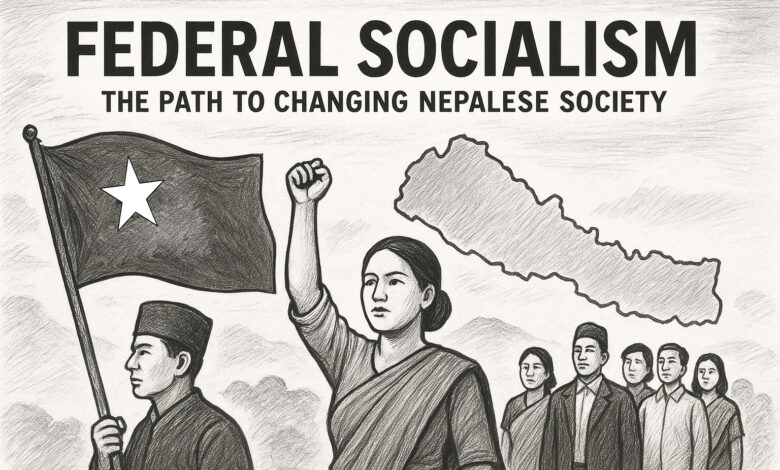
Federal Socialism is a doctrine developed through the practical experience of the Nepali socialist movement. It combines the core principles of federal governance in socialist system. It upholds the socio-economic goals of socialism to create a comprehensive and inclusive political system. It emphasizes that socialism must reflect each country’s unique history, society, and conditions, and therefore Nepal requires its own distinct socialist path. Federal Socialism seeks to combine federalism and socialism to address Nepal’s multi-cultural social structure and the class-based inequalities rooted in capitalism.
Federal Socialism envisions a system where: the state protects the vulnerable and marginalized, social justice and security are universal rights, national productivity increases and is distributed fairly, and opportunities are equal for all citizens. This doctrine is aimed at oppressed nationalities and the working class, seeking to explicitly define a federal socialist state model aligned with the country’s historical struggles for democracy, inclusion, and equity. It represents a doctrinal evolution of the 2006 People’s Movement and the 2015 Constitution’s commitment to socialism-oriented governance.
2. Core Ideas of Socialism
Socialism is a defined as system in which the means of production are socialized. In such a system, society becomes organized, capital does not dominate labor, and the working class is freed from capitalist exploitation. In socialist system, society is organized around justice and equality and the policy should be “work based on efficiency and remuneration based on work. For Nepal, this requires a mixed ownership model—state/public, cooperative/community, and private sectors—while gradually transforming the socio-economic structure.
This model incorporates both market mechanisms and planned development while ensuring accountability to society. The working class remains central to this transformation. This system must be applied in accordance with the latest scientific knowledge and discoveries, the experiences of world history, and the concrete conditions of Nepali society. It envisions socialism as an alternative to global capitalism and holds that each nation should follow its own distinct path of socialist transformation in accordance with its social character.
The doctrine adapts socialism to the contemporary era of information technology, artificial intelligence, and the knowledge-based economy. It argues that AI can strengthen the potential of socialism if used for public welfare rather than private profit. Socialism must be human-centered, equitable, and grounded in scientific reasoning.
3. Federal Socialism: The Nepalese Path to Socialism
Although Federal Socialism was endorsed in the party’s manifesto and constitution since 2012 AD, the doctrine was formally adopted at the First Federal Council Meeting of the People’s Socialist Party held on June 20–21, 2025, in Chyasal, Lalitpur District. The council unanimously passed the ideological document titled: The Nepalese Path to Socialism: Federal Socialism” reaffirming commitments to federalism, republicanism, secularism, proportional inclusion, and social justice.
Federal Socialism is a socialist theory developed through the practical experience of the Nepali revolution. Every theory evolves on the foundation of already proven ideas and serves as a guide for the whole movement. Its two main theoretical bases or “ISM” are federalism and socialism, both of which have been practiced and proven in various countries according to their specific historical and social contexts. After the promulgation of the federal system in September 2015 in Nepal, the administrative geography-based federal structure is applied. This is the centralist, political-elite-led federal structure. We proposed an identity-based federal structure rooted in historical background as an alternative. Federal socialism combined federal restructuring with a socialist democratic political economy rooted in Nepal’s multicultural realities.
In the country of multi-nationalities like Nepal, the combination of these two principles carries profound historical significance —”Federalism for the emancipation of oppressed nationalities and Socialism for the emancipation of the working class.” Therefore, in line with Nepal’s objective conditions, Federal Socialism has been put forward as the guiding principle of the Nepali revolution — socialism integrated with a federal system of governance.
Federal socialism thus unites the struggles for ethnic and class emancipation. It is, therefore, the emancipation of the working class and oppressed nationalities. It has systematized, at the theoretical level, the practice of socialism with multinational characteristics within the Nepali revolution. Its goal is the federalization of Nepali society and the socialization of the means of production. Socialism with a federal governance system is presented as Nepal’s distinctive route, advancing emancipation of both national and class simultaneously. Unlike traditional democracy, which limits itself to political democracy, federal socialism envisions economic, social, and cultural democracy as well.
This approach aims to build a prosperous 21st-century federal socialist state.
Federal Socialism draws on dialectical and historical materialism, Marxism, and global socialist experiences. It incorporates positive contributions from the world socialist movement while adapting them to Nepal’s specific realities. It seeks to guarantee civil, political, economic, social, and cultural rights and to build a society grounded in inclusion, justice, equality, and non-discrimination.
4. Philosophical and Ideological Basis of Federal Socialism
The philosophical and ideological foundation of federal socialism lies in dialectical and historical materialism, Marxism, and the experiences of the world socialist movement. The party manifesto states:
“This party, adhering to dialectical and historical materialism in the field of philosophy, shall embrace the positive contributions developed by Marxism and the various streams of the world socialist movement, and regard Federal Socialism as the guiding principle — the Nepali path to socialism. It shall guarantee not only the civil and political rights of the people but also their economic, social, and cultural rights. As a socialism of Nepali characteristics, Federal Socialism shall initiate and lead the task of building a democratic federal system, good governance, prosperity, social justice, and an equitable, just, and discrimination-free society.” This statement clarifies that Federal Socialism is philosophically dialectical-materialist, politically democratic, and socially welfare-oriented.
Marxism has greatly contributed to transforming society from metaphysics to science, from superstition to reason, and from mere contemplation to innovation. It has demonstrated that life and the universe are not mysterious but understandable—and that they can be changed. Without the scientific and technological leap of the modern world, Marxism would have remained merely a “story once told.” As science and technology advance into the era of artificial intelligence, the relevance of scientific socialism, which links socialism to science, has increased further. It has become widely accepted that human actions, grounded in scientific principles and the laws of nature, can transform society.
As the doctrine of the Nepali revolution, Federal Socialism will assimilate the positive contributions of Marxism, the national liberation movement, and the world socialist movement, adapting them to Nepal’s specific conditions. It will guide movements aimed at liberating society from all forms of class, ethnic, regional, and gender-based exploitation, oppression, discrimination, and inequality. In such a system, the state will become the guardian of those without guardians; the state will stand as the support for the helpless; social justice and security will become the fundamental rights of all citizens; and the growth and equitable distribution of national productivity will ensure equal access to life’s opportunities for all. Relying on the laws of nature and the scientific method, federal socialism asserts that all progress can be achieved by human effort.
5. Features of the Federal Socialism
Federal socialism, along with the freedoms of speech, press, assembly, and organization, will embrace the eternal values and principles of traditional democracy — such as people’s sovereignty, a pluralistic and open society, adult franchise, periodic elections, competitive multiparty system, constitutional and legal state, fundamental and human rights, separation of powers, independent judiciary, and the right to self-determination. In addition, the program incorporates the following ten core elements:
5.1 Federalism with Identity
Nepal’s identity-based federalism recognizes the country’s diverse nationalities—defined by shared culture, language, history, economy, and geography. This model ensures self-governance through a federal structure based on separation of powers, with a federal legislature, cooperative government, judiciary, and constitutional bodies. Provinces receive residual powers, minority protections, and authority over local governments. Autonomous provincial and special structures enable effective self-rule and democratic participation.
5.2 Socialist Economic–Political Direction
Socialism is viewed as a system grounded in justice, equality, freedom, prosperity, and the elimination of exploitation. Nepal adopts a gradual, stage-wise socialist transition, integrating market, state, and cooperative roles. Economic policies aim to expand social ownership of production and guide the national economy progressively toward socialist transformation. The doctrine advocates three staged economic strategy: 1. Socialism-oriented economy, 2. Mixed economy based on socialism, 3. Fully socialist economy.
5.3 Participatory and Inclusive Democracy
The doctrine emphasizes a democratic model that ensures representation for all classes, castes, genders, languages, religions, and cultural groups. Traditional liberal democracy is seen as insufficient because it provides only formal equality. Instead, a deeper, inclusive, and participatory democracy is proposed to bring historically marginalized groups into political decision-making.
5.4 Economic and Social Justice
Federal Socialism seeks to abolish inequality and discrimination across class, caste, gender, ethnicity, and other social categories. It envisions universal access to food, housing, education, healthcare, and employment. Marginalized groups will be protected, exploitation eliminated, and inclusive development promoted through increased production and equitable distribution of resources.
5.5 Egalitarian Prosperity and Human Well-being
The model aims for equitable prosperity and human dignity. While capitalism creates wealth alongside extreme inequality, socialism seeks to uplift workers, peasants, intellectuals, women, dalits, oppressed nationalities, and disadvantaged groups by ensuring equal access to resources, opportunities, and political power.
5.6 Good Governance and Integrity
Recognizing deep-rooted corruption in Nepal’s governance system, the framework prioritizes transparency and accountability. It proposes establishing an independent and impartial Janlokpal (public ombudsman) to investigate corruption, strengthen institutional integrity, and ensure citizen-driven oversight.
5.7 Proportional Electoral System and Inclusion
To ensure genuine representation, a fully proportional electoral system is proposed, replacing the current mixed model. All state institutions—including administration, security forces, and bureaucracy—must ensure 33% women’s representation and proportional inclusion of marginalized ethnic, regional, disabled, and gender–sexual minority groups, supported by affirmative action where necessary.
5.8 Welfare State with Social Protection
The doctrine envisions a welfare state that guarantees equality of opportunity, fair distribution of resources, and comprehensive social security. Social protection will be ensured for senior citizens, children, persons with disabilities, gender and sexual minorities, the unemployed, vulnerable populations, and all citizens unable to meet basic needs.
5.9 Environmental Balance and Protection
Acknowledging global environmental crises—such as pollution, industrialization, weapons proliferation, and climate change—the framework commits to ecological conservation and climate-sensitive development. All development activities must be environmentally balanced, sustainable, and just, while protecting biodiversity and minimizing disaster risks.
5.10 Plural and Multicultural Nationalism
Federal Socialism supports a multicultural national identity that respects and protects Nepal’s ethnic, linguistic, religious, and cultural diversity. It rejects caste-based hierarchies and discriminatory traditions, promoting a scientific and democratic national culture. Plural nationalism allows a shared national identity at the federal level and distinct regional identities within provinces, strengthening unity through inclusiveness rather than mono-ethnic nationalism.
6. Key features of Economic System
The party’s policy and program also include detailed provisions on macroeconomic policies, economic sectors, infrastructure development, social sectors, cultural transformation, national security, public administration, and various other subjects. Likewise, the document elaborates on the strategy, policy, and responsibilities for establishing a federal socialist system. The proposal critiques Nepal’s current economic direction as being dominated by “crony capitalism”—an alliance of political elites and business cartels that distorts federalism and undermines public welfare.
Federal Socialism advocates for:
· Promote a socialist market economy by making capital and markets accountable to society.
· Harmonized Implementation of economic, fiscal, and monetary policies and the budgetary system shall be restructured.
· Socialization of means of production and phase-wise construction of socialism.
· Fiscal Federalism, Financial Reforms, and Economic planning at federal and provincial levels.
· Coordination among Public, Cooperative, and Private Sectors and Regulation of Key Sectors by the Government.
· Production-based economy over rent-seeking and crony capitalism.
· Protection and promotion of agriculture, innovation, and cooperatives.
· Reduction of economic inequality through redistributive policies.
· Digital economy based on science and technology, and the use of artificial intelligence in all sectors
7. State and Ruing System
While strengthening the existing federal democratic republic, the strategic goal is to achieve a federal socialist system. The aim is to defend, consolidate, and advance political achievements and to build Nepal as an independent, sovereign, indivisible, non-discriminatory, democratic, secular, and federal socialist republic. We proposed constitutional and political reforms, including: A directly elected president, A fully proportional parliament, and Council of ministers from experts. This proposal aimed to enhance democratic stability, proportional representation of nationalities, and counter regressive and centralized power structures.
In terms of the state system and governance structure, in line with the principle of direct democracy, the federal government shall have an executive president elected by the people based on adult franchise. Similarly, provinces shall have chief ministers, special structures, and local levels shall have executive heads directly elected by the people and council of ministers from experts. No person shall serve as president for more than two terms. The president and vice president shall be from different genders, provinces, and nationalities and all levels of elections shall be held under an open-list proportional representation system.
Note: Writer is the Chairperson of the People’s Socialist Party, Federal Council.