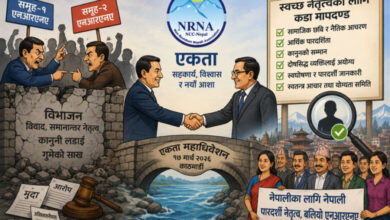

Why do Nepali people often fail to vote for capable candidates with strong ethics and vision, or for political parties with sound policies? This is because Nepali voters tend to base their voting decisions on a range of different criteria. These include loyalty to a particular political party, supporting candidates from one’s own family lineage or kinship network, returning favours to those who helped during difficult times, voting for a candidate who stands directly against one’s perceived enemy, rewarding those who helped secure jobs for oneself or family members, expectations of future employment or opportunities, hope of assistance in times of trouble, and even voting under the influence of friends and social circles.

Former French Emperor Napoleon Bonaparte once said that people are easily attracted not by grand policies but by small symbols, honors, emotions, and false promises. Similarly, former British Prime Minister Winston Churchill noted that many voters prioritize slogans, caste, religion, region, and short-term benefits over policy, competence, and long-term impact. These observations closely reflect tendencies found in Nepali society. In addition, there are further distortions, such as distributing money, forcing people to swear oaths to vote for a particular candidate, making voters touch copper as a ritual, or offering meat and alcohol in exchange for votes.
Individuals who are not affiliated with political parties, who are self-reliant and not dependent on anyone’s patronage or support, tend to vote based on party manifestos and policies. Such voters do not remain loyal to a single party; instead, they support capable individuals and good parties. These individuals and families are more commonly found in urban areas. However, it is difficult to determine what percentage of the total electorate they represent.
Nepali society is divided along caste, religion, geography, class, and gender lines. However, among the younger generation, the influence of these divisions is minimal or declining, particularly among educated urban populations. Let us examine these issues more deeply.
Despite the long establishment of a democratic system in Nepal, election results show that candidates with competence, integrity, and long-term vision, as well as political parties with clear policies, remain relatively weak. Instead, the same faces and the same patterns continue to repeat themselves. This highlights deep-rooted realities within Nepali society and political culture.
Public trust in politics in Nepal has been steadily declining. Unfulfilled promises, repeated corruption scandals, and weak practices of listening to citizens after attaining power have led many people to believe that “nothing will change even if good people come to power.” This pessimistic mindset discourages voters from supporting honest and visionary candidates.
Another major factor is economic hardship. A large section of the population is preoccupied with daily survival. Immediate relief, personal assistance, or small short-term benefits tend to attract voters more than long-term policies, good governance, and structural reforms. As a result, parties with future-oriented agendas are weakened because their policies do not offer instantly visible benefits.
Caste, regional, and kinship-based politics remain influential in Nepali society. Many voters make decisions based on whether a candidate is “one of us,” rather than on ethics or competence. This disadvantages capable candidates who are outsiders, who bring new ideas, or who are not connected to traditional networks.
The lack of political education and access to accurate information is another major issue. Many voters do not have the habit or opportunity to read party manifestos, understand policy differences, or analyze candidates’ long-term visions. Emotional speeches, catchy slogans, and misinformation spread through social media easily influence voter perceptions.
The growing influence of money in the electoral process has further marginalized ethical and capable candidates. Those who can spend heavily on campaigns, mobilize powerful networks, and display strength tend to dominate public attention. Candidates with good policies and vision often remain overlooked due to limited resources and publicity.
Ultimately, weak state institutions and ineffective implementation of laws have eroded public hope. Even parties with good policies often fail to deliver after coming to power due to institutional barriers, internal politics, and entrenched structures. This reinforces the perception that “policies remain confined to paper.”
Thus, the failure of voters to support capable candidates with integrity, vision, and sound policies is not merely a matter of low awareness. It is the outcome of complex social, economic, and institutional problems. Until political education, economic security, and institutional trust are strengthened, influence and access will continue to outweigh quality in democratic decision-making.
At various levels—from party headquarters to local ward committees—party organization and internal syndicates also play a decisive role in voting outcomes. As a result, popular leaders or parties may receive moral support but not necessarily electoral support. However, this does not apply universally. Many Nepalis consider elections a national festival, and voter participation in Nepal remains high compared to many other countries.
Internal party rebellions by leaders and activists denied opportunities, factionalism, and collusion between rival parties have also prevented voters from consistently supporting capable and ethical candidates. In recent times, Nepali society has become increasingly dependent on social media. Global practices show that so-called “deep state” influences—powerful external actors and institutions—can significantly shape political outcomes. Platforms such as Facebook, X, Instagram, and YouTube are produced and controlled by the United States. These platforms determine what content is shown or hidden, giving them immense influence. Deep-state actors often deploy individuals as agents without their awareness. Therefore, capable leaders and good parties must adapt to the new environment and remain vigilant against vote-buying, rumor-spreading through social media, and similar tactics. The Gen Z uprising of Bhadra 23–24, 2082 BS can be seen as one manifestation of the growing influence of social media.
Another important factor during elections is the fragmentation of smaller political parties and increased party-switching. This leads to vote swings, which can make election results unpredictable. Gaining the support of such parties or groups can therefore be decisive.
In conclusion, it is incorrect to assume that voters will automatically support capable candidates with integrity, vision, and good policies simply because they perform well. Voting decisions are influenced by many factors. While it is often said that the younger generation is apathetic toward politics, the Gen Z movement has surprised many and opened eyes. It is not that Nepali people never vote for capable and ethical candidates or good parties. Rather, voters’ criteria include party loyalty, family and kinship ties, who helped during difficult times, opposition to perceived enemies, job provision, expectations of future opportunities, hope for support in legal or personal trouble, and the influence of neighbors and friends. Moreover, the practice of buying votes with money often leads to victory for big spenders and defeat for more qualified candidates.
When candidates and parties use all means—money, influence, coercion, and manipulation—to win elections, unexpected expenses can ruin households and even displace families. Therefore, candidates must understand the real criteria guiding Nepali voters. In a democracy, the defeat of capable candidates is not primarily due to their weakness, but because voter decisions are often driven by emotion and self-interest.
biswasdip@ymail.com
21 January 2026 (8 Magh 2082 BS)