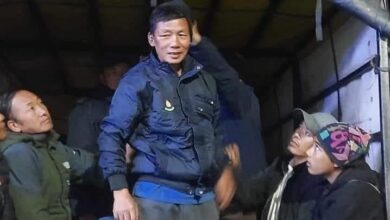
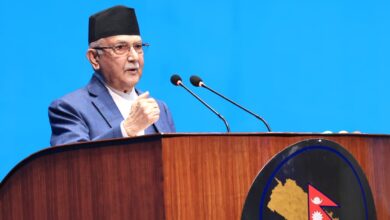
London, August 15, 2025 — The Non-Resident Nepali Association (NRNA) UK organized a grand “Meet and Greet” event in honor of former Managing Director of the Nepal Electricity Authority (NEA), Kulman Ghising, in Aldershot.
Hundreds gathered at the Empire Hall near London to welcome him and hear his words. Representatives of various organizations and individuals lined up on stage to offer him respect and honor.
Standing before the Gurkha community, whom he described as having made Aldershot their “second home,” Ghising acknowledged that Nepal’s identity has reached the world largely due to the contributions of the Gurkhas.
Before entering the venue, Ghising laid a wreath at the statue of Gurkha VC Kulbir Thapa in Aldershot’s Princes Gardens, paying tribute to the first Gurkha Victoria Cross recipient. The day coincided with Victory over Japan (VJ) Day, observed annually on August 15, marking Japan’s surrender in 1945 and the end of the Second World War.
Accompanied by panche baja and bagpipe tunes, along with a rally carrying Nepali and British flags, Ghising expressed deep pride as he entered the venue.
Addressing the gathering of leaders from 59 Nepali organizations in the UK, intellectuals, business figures, and community members, Ghising thanked the organizers for their warmth and hospitality. He said the affection and trust shown from the airport to the stage made this UK visit—his first in nearly two decades—an unforgettable experience.
Ghising remarked that although the government gave him “zero performance evaluation” and even initiated actions against him, the overwhelming love, goodwill, and trust from Nepalis at home and abroad over the past four months were the real measure of his work.
Highlighting Nepal’s global recognition through Mount Everest, Gautam Buddha, and the Gurkhas, his statement drew thunderous applause from the audience.
“The Gurkhas played a crucial role in safeguarding Nepal’s sovereignty and establishing our first diplomatic ties with Britain. That is our true heritage,” he said.
He also elaborated on his “Ujyalo Nepal Abhiyan” (Bright Nepal Campaign), explaining that prosperity cannot be achieved with electricity alone. “This campaign is about transformation in every sector—prosperity, change, social justice, new leadership, and turning despair into hope. I want to connect Nepalis across the world in this mission, and with your support, I am confident it will succeed,” he said.
Drawing on his 30 years of experience in the power sector, including 12 years in executive leadership, Ghising recalled that Nepal’s first hydropower project, the Pharping Hydropower Plant (built with British assistance in 1911), symbolized this long-standing partnership.
During his eight-year tenure as NEA Managing Director, he oversaw 100% electricity access across the population, raised production to 4,000 MW, and placed another 7,000 MW under construction. He noted that electricity production grew nearly five-fold after opening the sector to private investment. Nepal now exports around 1,000 MW to India and Bangladesh.
Last year alone, Nepal exported electricity worth NPR 17 billion, while imports stood at only NPR 12 billion. He also highlighted that an institution running in losses for 30 years had been transformed into one making nearly NPR 90 billion in profit under his leadership.
Touching on labour migration, Ghising lamented the plight of migrant workers. Despite remittances bringing in NPR 15 trillion annually—about NPR 7 trillion from Gulf countries alone—he said the state often neglects or humiliates these workers.

“Remittances contribute 27% to our GDP and sustain our economy through foreign exchange. Yet, Nepalis in the Gulf are disrespected, their children denied citizenship, while Nepalis in Europe, America, and elsewhere face barriers to returning or investing back home. This is not right,” he said.
Having visited four Gulf countries before coming to the UK, Ghising stressed the dignity and rights of migrants.
Special guest Lt. Col. (Retd.) Tol Khanchha Magar emphasized that the Gurkhas have become a global “brand,” urging the UK government to reconsider equal pensions and benefits. Another guest, Hari Singh Waiba, Chair of Tamu Dhee UK, asserted that Nepal now needs Ghising’s leadership for prosperity, as the public has grown weary of traditional parties. He assured that Nepalis in the UK would fully support him if he entered politics.
NRNA UK President Prem Gaha Magar thanked all the participating organizations and individuals for their support and expressed gratitude to Ghising for gracing the event. The program was formally conducted by General Secretary Jurendra Khajum, with Vice President and Coordinator Anil Malla delivering the welcome speech.
In the second session, NRNA UK Women’s Secretary Januka Rai led the cultural segment, featuring performances by the MONA UK Cultural Team. The program included Tamang selos, Khukuri dance, and songs by the first Nepali Tara winner Deepak Limbu. The Pratham Naumati Baja Gulmi UK group performed panche baja to welcome Ghising.